Showing posts with label Inspirations from Sanskrit. Show all posts

Thursday, July 16, 2026

How did Rishi Valmiki get to compose the Ramayana?


( Image of Vaduvur Ramar)


How did Rishi Valmiki get to compose the Ramayana?

Role of Dhyana in Indian Sculpture & Poetry

All begins with the intention of the poet, here Valmiki's intention.

Intention of the Poet

Saint Narada visits the hermitage of Valmiki. The follow account is taken from Chapter 1 of Balakanda. (Valmiki Ramayana)

तपस्स्वाध्यायनिरतं तपस्वी वाग्विदां वरम् ।
नारदं परिपप्रच्छ वाल्मीकिर्मुनिपुङ्गवम् ।।1.1.1।।

Ascetic Valmiki enquired of Narada, preeminent among the sages ever engaged in the practice of religious austerities or study of the Vedas and best among the eloquent.

कोन्वस्मिन्साम्प्रतं लोके गुणवान्कश्च वीर्यवान् ।
धर्मज्ञश्च कृतज्ञश्च सत्यवाक्यो दृढव्रत:।।1.1.2।।


“Who in this world lives today endowed with excellent qualities, prowess, righteousness, gratitude, truthfulness and firmness in his vows?

चारित्रेण च को युक्तस्सर्वभूतेषु को हित: ।
विद्वान्क: कस्समर्थश्च कश्चैकप्रियदर्शन: ।।1.1.3।।

Who is that one gifted with good conduct, given to the wellbeing of all living creatures, learned in the lore (knowledge of all things that is known), capable of doing things which others cannot do and singularly handsome?

एतदिच्छाम्यहं श्रोतुं परं कौतूहलं हि मे ।
महर्षे त्वं समर्थोऽसि ज्ञातुमेवंविधं नरम् ।।1.1.5।।

O Maharshi, I intend to hear about such a man whom you are able to place? Indeed great is my curiosity”.

Following which Saint Narada, gives us an account of story of Rama as ‘Samkshepa Ramayanam’’ which is Chapter 1 of Balakanda.


Inspiration – evoking rasa – sight of the kraunca birds
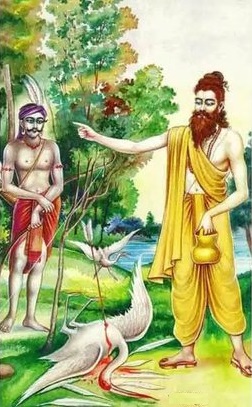
(Figure – Sage Valmiki cursing the hunter for killing the male Krauncha bird with an arrow)

Valmiki goes to river Tamasa for morning ablutions’. He sees a male krauncha being shot down by a hunter — expresses the reflection of a female companion’s sorrow in his experience in the form of a sloka in metrical form.

मा निषाद प्रतिष्ठां त्वमगमश्शाश्वतीस्समा: ।

यत्क्रौञ्चमिथुनादेकमवधी: काममोहितम् ।।1.2.15।।

“O fowler, since you have killed one of the pair of infatuated kraunchas you will be permanently deprived of your position”.

Valmiki who had witnessed all that had happened was filled with compassion. He involuntarily burst into a poetic verse that seemed to flow out, spontaneously without any effort on his part. “O Fowler! Thou hast so cruelly killed the male of a pair of Krauncha birds while they reveled. On that account you will be discredited forever. Just as you ended the bird’s life before its time, so too shall wilt your life before its time”. Having uttered his versified curse, Valmiki became thoughtful, “What has come over me? Why did I curse a fellow being? Was it my sorrow at the helpless wailing of a bird or does it have a hidden meaning? Born out of the pathos of a slain bird, some words have escaped me without my conscious effort. They are so arranged as to follow a metre and are viable for rendition in the form of a song, to the accompaniment of string instruments, hence let it be known as a ‘sloka’.


Power of clairvoyance by Lord Brahma

Lord Brahma appears at the hermitage — directs him to compose the great poem in the same metre describing the story of Rama as related by Narada — grants him the power of clairvoyance.

रहस्यं च प्रकाशं च यद्वृत्तं तस्य धीमत: ।

रामस्य सहसौमित्रेः राक्षसानां च सर्वश: ।।1.2.33।।

वैदेह्याश्चैव यद्वृत्तं प्रकाशं यदि वा रह: ।

तच्चाप्यविदितं सर्वं विदितं ते भविष्यति ।।1.2.34।।

The incidents pertaining to sagacious Rama together with Lakshmana, Sita, Bharata, etc. and the rakshasas their deeds, thoughts, unknown or known to everybody and even not known to you, will be revealed to you by my grace.


Saturday, December 23, 2023

Dolothsavam - Shri Shri Anna Lyrics


Shri Shri Krishna Premi Anna, passed away on August 31,2023. He has left us a treasure trove of krithis, slokas and charitras. 

Off the same, the dolothsavam krithis on Krishna and Rama are very popular. Have been singing the same same as Nitya-upachara every day. 

Sarvae Jana Sukhino Bhavantu

Samastha Sanmangalani Bhavantu 


Lyrics - Dolotsavam  - Krishna


Ragam: Shankara Bharanam                                                        Talam: Adi

Radha Kalyana Vaibhavame

Kaalindha Kulavana Kunja Kuthire
Kethaki Kandhayuda Manda Samere||

Sarasa Samullasida Divya Vasanthe
Champaka Chokadi Kusuma Sugandhe||

Mandara Chandanadhi Vitapi Vethe
Brindavane Prema Madhura Geete||

Ragam: Kapi                                                                               Talam: Adi

Swagatham Swagatham Sringara Loola
Swamin Vijaye Bhava Gopala ||

Kanakaam Bharadhara Kanjaja Vinutha
Koustuba Bhushana Kamala Nanda ||

Gopa Kumara Kudoohala Leela
Kolahala Rasa Keeli Vilola||

Premika Bhavuka Hridaya Vilasa
Prathita Charitra Mridhutara Hasa||

Ragam: Sriragam                                                                 Talam: Desadi
{Offer Chandana, Flower, Rose Water (Paneer) To Lord Krishna}

Swaragatham Swagatham Swagatham Krishna
Sharanagata Paripalaka Karunakara Krishna||

Upavicha Kisalaya Mridhutalpe Krishna
Shubakara Sucharithra Sundara Krishna||

Kousthuba Bhooshana Kanakambara Krishna
Kaliya Nardhana Kamala Priya Krishna||

Vrindavana Sanchara Nandathmaja Krishna
Bramhadhi Sura Pujitha Premika Krishna||

Ragam: Kapi                                                                               Talam: Adi
{Tilakam To The Sri Krishna & Show His Mesmerizing Beauty In A Mirror}

Sringara Rasika Sri Hare Natha ||

Srita Jana Vathsala, Sri Pathe Deva
Sridhara Parimala Gandham Dehi||

Makara Kundala Shobita Karna
Manasija Koti Sama Lavanya||

Vanaja Vilochana Vanamala Dhara
Vividha Kusuma Malam Dehi||

Premadha Manjula Vachana Nimagna
Premika Hridayam Bo Bhava Lagna||

Ragam: Sohini                                                                      Talam: Adi
{Offer Nalungu To The Lotus Feet Of Lord Sri Krishna}

Alokaye Sakhi Vrisha Banu Nandhineem||

Mandasameere Madura Nikunje
Madanavilase Madukara Punje||

Mrigamada Tilakam Vilikadhi Chore:
Mukura Manim Darsayathi Murare: ||

Hemalatha Sama Lalitham Vinatham
Premika Gopeem Mandala Militham ||

Ragam: Shankarabharanam                                                  Talam: Adi
{Offer Flower Ball (Poochendu) To Lord Sri Krishna}
Jaya Jaya Madhana Manohara Roopa
Vraja Vanita Jana Manasa Deepa||

Anjalina Yache Dhayayaa
Anudhina Mevam Vihara Mayaa||

Laksham Vilikeyam Pahi
Lakshmi Ramana Charanam Dehi||

Premika Hridaya Pushpa Vasantham
Prakatitha Madura Tulasi Kanda||

Ragam: Sama                                                                                    Talam: Adi

Viharathi Vanamali Sri Radhaya ||

Kandaga Leelaya Kunja Gruheshu
Kalindhi Thata Keli Vaneshu||

Sanchala Kundala Charu Kapolaha:
Sanchala Kundala Sajjitha Kalaha ||

Sakhi Jana Mandala Keli Vilola:
Sarasa Prema Nimgna Vilasa ||

Ragam: Anandabhairavi                                                                   Talam: Adi

Kamakoti Sama Komala Shyamalanga
Kaliya Banamani Mukuta Ranga|
Vrindavanantha Padaravindha
Vrajaraja Nandana Sri Govinda||

Govardhanodhara Gopikajara
Go Gopa Gopi Jana Chittachora|
Makara Kundala Dhara Divya Pithambhara
Mandahasa Mukha Shera Chora||

Kamsadhi Vairijana Garva Chosha
Kousthubadhi Divya Varamani Bhusha|
Kamadhi Dhosha Rahita, Bhakta Posha
Kamaniya Soundarya Prema Vesha||

Raga: Ananda Bhairavi                                                                                   Talam: Jampai
{Offer Betel Leaf (Beeda) To The Lord}

Jaya Jaya Srimathi Vrishabhanu Nandini
Paripalitha Vrajaraja Dhani|
Vrijaraja Nandana Hridaya Nandhini
Rathi Koti Soundarya Rathna Peeti||

Gogopa Gopijana Chitta Mohini
Komala Thathithsama Sundara Rangi|
Vrindavavana Thara Kunja Viharini
Vrijaraja Vanchita Charu Harini||

Sarasa Samullasita Mandahase
Sharana Gatha Jana Pariposhe|
Sajjitha Parishkara Divya Bhushe
Sahala Prakatitha Krishna Premarase||

Mandara Chandana Sugandha Viluptha Bringe
Vrindavane Madana Keli Nikunja Gehe|
Uthpulla Pushpa Lathika Kritha Dolikayam
Sri Radhaya Saha Nishanna Mananda Meede||

Raga: Ananda Bhairavi                                                        Talam: Tripatai

Alokaya Sakhi Ananda Gopalam||

Lalithadhi Priya Vanitha Valitham
Lalitha Bhavane Radha Militham||

Chanchala Lalitha Dola Hridaye
Chandana Charchita Hridayam Kalaye||

Premika Hridaya Prema Tava Danam
Prasura Sarobhava Sundara Nayanam||


Raga: Shankarabharanam                                                       Talam: Jampai
{Offer Flower, Fruit & Milk To Lord Sri Krishna}

Jaya Radhika Ramana, Jaya Kamsa Harana
Jaya Kaliya Dhamana, Jaya Kamala Charana ||Laali||

Jaya Nandavara Puthra, Jaya Nalina Nethra
Jaya Meghashyama Gathra, Jaya Param Pavithra ||Laali||

Jaya Gopika Lola, Jaya Gopabala
Jaya Kasturibala, Jaya Baktha Pala ||Laali||

Jaya Navanetha Moksha, Jaya Rahita Dhosha
Jaya Varamani Bhusha, Jaya Prema Bhasha ||Laali||

Raga: Sindu Bhairavi                                                      Talam: Adi
{Offer Flower, Fruit & Milk To Lord Sri Krishna}

Sukumara Sundara Kshera Chora
Kshera Chora Chitha Chora ||

Sulabha Gunalaya Sundara Roopa
Swadhu Bhaya: Deepa Sarasijanabha||

Govardhano Dhara Gopi Rasika
Gokula Rakshaka Gopa Kishora||

Munijana Pala Murali Lola
Mukaritha Nupura Prema Da Leela||

Raga: Abhogi                                                       Talam: Adi
{Offer Tambulam To Sri Krishna}

Leela Rasika Lavanya Sheela||

Govardhano Dhara Gopi Lola
Komala Tambulam Dhara Nela ||

Sri Vraja Raja Sritha Jana Pala
Sri Vrisha Bhanu Sutha Priya Sheela||

Prema Vialsa Prakatana Lola
Prema Nimagna Sri Gopala||

Raga: Punnagavarali                                              Talam:Adi

Yevam Bhavathu Tava Kainkaryam, Dine Dine Krishna

Devaki Nandana Divya Charitra
Devala Naradha Kirthana Patra ||

Tava Naama Sudham Rasana Rasathu
Tava Roopam Nayana Yugalam Pasyathu
Bhavan Mama Hridaye Sadha Vasathu
Bhavukadha Sadha Maye Vilasathu||

Shiropi Mam Tavam Bhakthya Namathu
Karopi Tulasi Samarpanam Karothu
Bhagavatham Mama Rasana Padathu
Padayugalam Tava Kirthane Nadathu||

Mama Janmetham Sapalam Bhavathu
Mahatham Seva Satatham Bhavathu
Madura Prema Sukam Bhavathu
Mangalam Sarvathra Sada Bhavathu||

Raga: Karaharapriya                                                            Talam:Adi

Mamaka Maparadam Sada Krishna
Madhava Kripaya Kshamasva

Shanka Chakradhara Pankaja Neetra
Shankara Vinutha Shyamala Gatra ||

Kanakam Bharadhara Kamala Lola
Kaivalya Pradha Sajjana Bala||

Bramhadhi Sura Pujitha Padha
Premika Hridaya Nagara Nada||

Raga: Suruthi                                                                      Talam:Adi
{ Before Singing This Song, Put Curtain To The Lord}

Mangalam Yugala Jyothi Shey
Naragatha Yugala Jyothishey

Mangala Namne Mangala Dhamne
Mangala Premne Mangala Bhoomne||

Sarwa Mangala Vigrahaya
Sarwa Mangala Nigrahaya||

Mangalam Nithya Mangalam Shubha
Mangalam Jaya Mangalam||

Ragan: Neelambari                                                         Talam: Triputa
{Song To Put Sri Krishna To Sleep}

Seshva Sukham Prabho Sesha Shayana

Sanakadhi Munigana Sevitha Charana
Shankha Chakradhara Sarva Charanya ||Seshavasukam||

Kamala Lalitha Komala Padha
Kamala Vilochana Kaivalya Nadha ||Seshavasukam||

Pithambhara Vanamala Bhusha
Premika Bhavuka Hridaya Nivasa ||Seshavasukam||

Ragam: Reethigowla                                               Talam: Adi
{‘Sleep Well’ Wishes To Bhagavan Sri Krishna Chandra}

Sheshva Sukham, Sri Gopi Natha

Sarasa Vasantha Manohara Kunje
Sarasija Sumadhala Kerne Manje ||

Sharadha Chandro, Raajathi Gagane
Sarasam Gaayathi, Go Go Vibhine||

Kusumaa Valiraphi Hrishta Kunje
Kojathi Bringo, Vallari Punje||

Premika Manasa, Virachita Krida
Prarthita Munivara, Karuna Needha ||

Priyae Charusheelae


Background:

Krishna goes to Radha in order to appease her anger.

Krishna asks her to give up on her anger.

The poem talks of this situation.


प्रिये चारुशिले
मुन्च मयि मनं अनिदानं |
सपदि मदनानलो दहति मम मानसम्
देहि मुख-कमला-मधुपानं ||ध्रुवपदं ||

Priye Charusheele Muncha Mayi Maanam Anidhanam.


Tuesday, November 28, 2023

Meghadutam & Yogini Ekadasi (A note on Reading between the lines)

The story of Meghadutam revolves around a love-lorn Yaksha, sending the cloud as a messenger to his beloved. 

The stroy captures, the scenic beauty as the cloud travels across the terrain etc.

The topic of 'clouds as messengers' is reserved for a yet another post, and maybe yet another blog :)

But, the resemblance of the story to the 'vrat katha' to Yogini Ekadasi, is what Im interested in. 

More on the same sometime later, 

Yogini ekadasi vrat katha

https://iskcondesiretree.com/page/yogini-ekadasi


Sunday, January 15, 2023

A Glimpse of Kāvyālankāra in Shankara’s Saundarya Lahari - Compiled By –Durga


In exploring the poetic beauty of Shankara’s works, the Saundarya Lahari is regarded as the crest of devotional poetry.

The metre in which it is composed is called the ‘’Sikharini’’ and has 17 syllables per foot. In Sikharini, the division is into 6 and 11 syllables.

Visual Imagery in Sanskrit Literature

In the Sanskrit scholastic tradition, knowledge isn't pigeon hoarded into subjects as we see it now in schools and universities. Like for instance, descriptions of plants may not just be confined to the texts of botany or medicine. But, we will also find, a vedic hymn, which has ritual and spiritual significance also having beautiful poetry and imagery. A text of poetry will include descriptions of war but will also have descriptions of beautiful landscapes and it'll have the subject matter of biology or ecology as well.

What is interesting to note is, how does a poet takes dry fact and converts it into evocative poetry. This timeless attribute, transcends geography and culture.

All of us are able to appreciate that, when the poet through his special eye, through his special vision, is able to transform something that is not everyday into something that is charming.

Shankara Bhagavatpada in poetic eloquence begins the ‘Soundarya Lahari’ with the verse , extolling the greatness of Devi.

शिवः  शक्थ्यायुक्तो  यदि  भवत:  शक्तः  प्रभवितुं
  चे देवं  देवो    खलु  कुशलः  स्पन्दितुमपि
अत: त्वां  आराध्याम्  हरि हर  विरिञ्चदिभिरपी
प्रणन्तुं  स्तोतुं  वा  कथं  अकृत-पुण्यः  प्रभवति।।


Translation:

“Shiva becomes capable of creating the Universe, only when united with Shakthi (Thee), but otherwise (when not so joined with Thee), He is incapable of even a stir, How then could one, who has not acquired merit (punya)- in this and previous births worship Thee or atleast praise Thee, who is adored even by Vishnu, Shiva, Brahma and others?”

In exploring this verse, Sita Devi in the ‘Sundara-kanda’ (Chapter 21-15 verse) tells Ravana, “अनन्या राघवेणाहं भास्करेण प्रभा यथा ”. “I am inseparable from Raghava like light from the Sun.”

Are the waves of the sea ever separate from the sea? Is the light ever separate from its source? “Without Devi, can Parameshwara ever stir?” Shankara Bhagavatpada expounds the greatness of Devi by stating that the first vibration by which the Parabrahman becomes aware of itself is caused by ‘Devi’.


The Sentiment of Love – Kalidasa’s Vs Shakara’s employment of Shringara rasa

“As the sun lights up the moon, love has the power to illuminate our hearts”.

Depiction of the season of Spring

The intimate relation between nature and humanity, established in early lyrical imagery finds expression in various ways in Kalidassa’s poetical symbolism.

The Ṛtusaṃhāra which, on account of its simple diction and less mature imagery, may be considered as the earliest composition of Kalidsa, is nevertheless proof of his intense appreciation of nature, which has determined the entire trend of his poetry and drama. Ritusamhara –literally it translates as the “Medley of seasons”. The changing seasons are depicted against the thematic backdrop of how lovers react to the landscape. This imbues the poem with a strong strand of erotic love (shringara) rasa.

Kalidasa, describes the beauty of Srping season starting with this verse.


प्रफुल्लचूताङ्कुरतीक्ष्णसायो
द्विरेफमालाविलसद्धनुर्गुणः।
मनांसि वेद्धुम् सुरतप्रसङ्गिनां
वसन्तयोद्धा समुपागतः प्रिये॥६-

praphullacūtāṅkuratīkṣṇasāyo
dvirephamālāvilasaddhanurguṇaḥ |
manāṁsi veddhum surataprasaṅgināṁ
vasantayoddhā samupāgataḥ priye    ||6-1||

The translation is as follows:

"Oh, dear, with just unfolded tender leaflets of Mango trees as his incisive arrows, shining strings of honeybees as his bowstring, the assailant named vasanta came very nigh, to afflict the hearts of those that are fully engaged in affairs of lovemaking.. [6-1]

द्रुमाः सपुष्पाः सलिलम् सपद्मं
स्तिर्यः सकामाः पवनः सुगन्धिः।
सुखाः प्रदोषा दिवसाश् रम्याः
सर्वम् प्रिये चारुतरम् वसन्ते॥६-

drumāḥ sapuṣpāḥ salilam sapadmaṁ
stiryaḥ sakāmāḥ pavanaḥ sugandhiḥ |
sukhāḥ pradoṣā divasāś ca ramyāḥ
sarvam priye cārutaram vasante ||6-2||

"Oh, dear, vernal trees are full with flowers, waters filled with lotuses, breezes loaded with their fragrances blowing agreeably, thereby both the eventides and daytimes are pleasant with thosefragrant breezes, whereby the women are with concupiscence, and thus everything is highly pleasingnow. [6-2]

Kalidasa connects the onset or the arrival of the Vasanta – season of spring with the arrival of the god of love.  Looking a little into Hindu Mythology, we have the Deva Kamadeva - The God of love – represented as a young, handsome winged man with green skin who wields a bow and arrows. His bow is made of sugarcane with a string of honeybees, and his arrows are decorated with five kinds of fragrant flowers. The five flowers are Ashoka tree flowers, white and blue lotus flowers, Mallika plant (Jasmine) and Mango tree flowers.

In stanza 6 of Saundarya Lahari, Shankara brings a similar visualization.

धनुः पौष्पं मौर्वी मधुकरमयी पञ्च विशिखाः
वसन्तः सामन्तो मलयमरु-दायोधन-रथः
तथाप्येकः सर्वं हिमगिरिसुते कामपि कृपां
अपाङ्गात्ते लब्ध्वा जगदिद-मनङ्गो विजयते 6

Translation: Oh daughter of the snow-clad Himalaya mountain! Kaamadeva, the God of love, has only a bow made of arrows, with its string comprised of a cluster of honeybees, and arrows barely five. The spring season (periodical and undependable) is his assistant and the southern breeze, his war-chariot. Yet, with such frail equipment, bodiless and alone though he be, Manmatha conquers the entire Universe, having obtained some favor through Thy’s benign side-glance.

In Pujyasri Chandrasekarendra Saraswati Swami speech, he highlights, the essence of the stanza as follows:

“With weapons by no means strong, Manmatha – the God of love triumphs all over the world. What is it that gives him such power? It is Devi’s sidelong glance.”

The idea of “vasantah sāmantah” brings out how Manmatha’s companion, the Spring season stirs the passion of all.

The chariot on which Manmatha rides, is referred as the “Malayamarudāyodhana-rathah”, translating as the cool winds redolent of the scent of sandalwood from the mountain called Malaya.

Compassion as an antidote to even Dispassion (Karunya bhava vs Vairagya)

“I slept and dreamt that life was joy. I awoke and saw that life was service. I acted and behold, service was joy.” - Rabindranath Tagore

A question that arises in the mind of readers of the Saundarya Lahari is, how can Shankara-bhagavatpada, write poetry rich in Shringara –rasa?

The 68th Acharya of Kanchi, had given a wonderful exposition on the same in his speech’s.

“Compassion is the manifestation of love in its mature form. It is the highest form of all love, flowing from the fountain that is the Paramatman. That is why it is said later in the Saundaryalahari (Stanza 93): “The entity called Sambhu, that is the colorless Parabrahman, assumes the form of aruna(red) for the purpose of protecting the world; indeed becomes his aruna out of his karuna or compassion; and goes about triumphantly (“Jagat tratum Sambor jayati karuna kachidaruna”). In the previous stanza Sankara says: “The light of your darkness falling on Paramesvara who is as bright as a crystal, makes him an embodiment of love (srngara).”

In the same vein, in discussing the emotion of ‘compassion’, Kalidasa’s in ‘Rtusamhara’, depicts the forgotten mutual animosity between a frog and a snake in the heat of summer’s oblivion. The verse is as below:

विवस्वता तीक्ष्णतरांशुमालिना सपङ्कतोयात् सरसोऽभितापिताः।
 
उत्प्लुत्य भेकस्तृषितस्य भोगिनाः फणातपत्रस्य तले निषीदति -१८

vivasvatā tīkṣṇatarāṁśumālinā
sapaṅkatoyāt saraso'bhitāpitāḥ |
utplutya bhekastṛṣitasya bhogināḥ
phaṇātapatrasya tale niṣīdati || 1-18||


Translation:

"Seared highly with scorching sunrays a frog jumped out of a slimy pond with clammy water, and sat under the hood of a snake as if by a parasol - a summerly oblivion of their mutual animosity.”

Episode of the ‘Frog and Snake’ at Shringeri

It is pertinent to note here, the Episode of the ‘Frog and Snake’ at Shringeri. When Shankara came to Sringeri, he saw an unusual sight on the banks of the Tunga. A cobra was seen spreading out its hood over a frog in labour pains, to give it shadow from the scorching mid-day sun. Struck with the sanctity of the place, which could infuse love between natural adversaries, the Acharya chose this very location to establish the Sringeri Math.

Shankara’s Kāvyālankāra

The Sanskrit term ‘alankara’, whose literal meaning is, ‘that which adorns’ or ‘ornament’, has acquired a wide range of connotations as scholasticism progressed and eventually been used to denote loosely, the entire discipline of poetics ‘alankar-sastra’.

In Anandavardhana’s theory of dhvani, in his work ‘Dhvanyaloka, he says that it behoves not only the poet but also the aesthete to understand dhvani for the best ideas are presented through suggestion and not through expressed words, for endless are the meanings of such poetry and the soul of poetry is suggestion. Anandavardhana further asserts that “it(dhvani) is not understood by a mere learning in grammar and in dictionary. It is understood only by those who have an insight into the true significance of poetry.” And he goes onto say that the “(suggested) meaning remains beyond the understanding of persons with a grounding merely in the science of meaning and words but averse to aesthetic contemplation of the intrinsic significance of poetry.”

Kanchi Acharya, Pujyasri Chandrasekarendra Saraswati Swami remarks, “to people reading the Saundaryalahari any number of hidden or inner meanings will reveal themselves according to their perception, maturity, leaning, nature and standing in life…..”

“If, out of compassion of Ambā, one or more from amongst you present new meanings to me it will be a great ratnābhiseka or muktābiseka for me.”


References:

Dehejia, H. V. (1996). Advaita of Art. Motilal Banarsidass Publishers.

Saraswati, S. C. (2018). Saundaryalahari. Bharatiya Vidya Bhavan.


Website references:

Ritu Samharam translations and text- https://sanskritdocuments.org/sites/giirvaani/giirvaani/rs/rs_1.htm


List

Blog Archive

Foreplay