
i cannot love you gently,
its not in me
to love in part,
so I will love you completely
& a little madly....
---Mathew Spencer


And I know I'm gonna love you for a long long time.....
I love her as she is doing her thing;
I would never want to control her fire;
All I need is to be near her....
धर्मो रक्षति रक्षितः

Within the Indian ethos, money called as धनम् (dhanam), has been revered as the goddess Maha Lakshmi. A daughter is revered as, the incarnate of the Devi herself.
A while back, I wrote a post titled, Sreshta Janakah, — the ideal father. https://medium.com/@thelightwithinme/%E0%A4%B6%E0%A5%8D%E0%A4%B0%E0%A5%87%E0%A4%B7%E0%A5%8D%E0%A4%A0%E0%A4%83-%E0%A4%9C%E0%A4%A8%E0%A4%95%E0%A4%83-a147b4f9dbb0
What makes King Janaka worthy of Sita, who is but the incarnate of Maha Lakshmi herself? It is his unwavering alignment with Dharma and Atma-Jnana — inner wisdom. A father walking the path of truth and righteousness becomes a vessel worthy of divine grace.
Freedom from the Money Culture — Lynne Twist
https://www.youtube.com/watch?v=jQviPghhtus&t=524s
In this vein, I was listening to the speech of Lynne Twist, “Freedom from the Money Culture”. She describes her two fund raising experiences,
Western vs Eastern Philosphical approach to Money

I was incidentally, reminded very contrarily to the opening scene in — the film, The Big Short. While, I found the film educational, the opening scene, lines hurt me deep. This view was jarringly evident in the opening scene that painfully exposed the cynical underbelly of money culture among Wall Street elites.
In popular western culture, money is just another commodity, absolutely transactional. Whereas, within, Eastern philosophilies, Money is Maha Lakshmi, revered, respected and deeply honored. It has a life, and energy of its own. You respect and honour her, she will stay with you. If you misuse her, she turns into fire. This is not mere metaphor — it is energy law, spiritual truth. Ravana’s empire was rich, yet when rooted in Adharma, it crumbled to ash.
Moana, Te Fiti, and the Feminine Principle
Moana, the disney animation picture, starts with, a tone, where the coconuts are stale, the island in struck by a sort, in-auspiciouness. All until, the protagonist, Moana restores the heart of the Island Goddess Te Fiti.
The island goddess, is portrayed as rageful, blowing with volcanic ash and where her heart is restored, akin to the Manipura chakra (green in color) — she is a back to a prosperous green island, bringing prosperity back to her nearby islands.
Prosperity is not a function of force or greed — it is a function of wholeness and restoration.
Honor of a Woman & Sacred Feminine
This reverence extends to the feminine principle itself. Kanyadan — the giving away of a daughter in marriage — has been criticized by modern feminists as patriarchal. Yet, in its original spirit, it is an act of entrusting a sacred being, not transferring property. A daughter is not an object; she is the goddess incarnate. Protecting her dignity is not subjugation — it is Seva. Of course, the feminine today must — and is — awakening her solar archetype too: not just to be revered, but to lead, create, and protect in her own right.
I’m reminded of the poignant Tamil film Mahanadi, where the hero, having lost his wealth in an investment scam, is faced with the harrowing reality of his daughter’s near fall into prostitution, only to be saved by her father ultimately. It’s a heartbreaking moment that underlines a deeper truth: when money is not rooted in dharma, it doesn’t just vanish — it corrodes everything it touches.
We must return to a sacred relationship with wealth. Not fear it, not chase it blindly, but honor it. Let it flow, where it does the most good. Like water, it nourishes when pure — and drowns when hoarded or corrupted. Money is not just a commodity, it is current, it has a life, of its own. If you are in the path of Dharma, she will stay. If you are in the path of adharma — she will burn what lies in her way, like how Ravana’s prosperity was burnt to ashes.
May we all walk the path where Maha Lakshmi feels at home. In truth. In dharma. In reverence.
Dharmo Rakshati Rakshitaha!

How did Rishi Valmiki get to compose the Ramayana?
Role of Dhyana in Indian Sculpture & Poetry
All begins with the intention of the poet, here Valmiki's intention.
Intention of the Poet
Saint Narada visits the hermitage of Valmiki. The follow account is taken from Chapter 1 of Balakanda. (Valmiki Ramayana)
तपस्स्वाध्यायनिरतं तपस्वी वाग्विदां वरम् ।
नारदं परिपप्रच्छ वाल्मीकिर्मुनिपुङ्गवम् ।।1.1.1।।
Ascetic Valmiki enquired of Narada, preeminent among the sages ever engaged in the practice of religious austerities or study of the Vedas and best among the eloquent.
कोन्वस्मिन्साम्प्रतं लोके गुणवान्कश्च वीर्यवान् ।
धर्मज्ञश्च कृतज्ञश्च सत्यवाक्यो दृढव्रत:।।1.1.2।।

“Who in this world lives today endowed with excellent qualities, prowess, righteousness, gratitude, truthfulness and firmness in his vows?
चारित्रेण च को युक्तस्सर्वभूतेषु को हित: ।
विद्वान्क: कस्समर्थश्च कश्चैकप्रियदर्शन: ।।1.1.3।।
Who is that one gifted with good conduct, given to the wellbeing of all living creatures, learned in the lore (knowledge of all things that is known), capable of doing things which others cannot do and singularly handsome?
एतदिच्छाम्यहं श्रोतुं परं कौतूहलं हि मे ।
महर्षे त्वं समर्थोऽसि ज्ञातुमेवंविधं नरम् ।।1.1.5।।
O Maharshi, I intend to hear about such a man whom you are able to place? Indeed great is my curiosity”.
Following which Saint Narada, gives us an account of story of Rama as ‘Samkshepa Ramayanam’’ which is Chapter 1 of Balakanda.

Inspiration – evoking rasa – sight of the kraunca birds
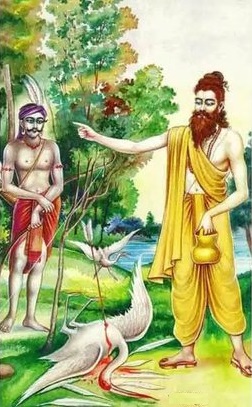
(Figure – Sage Valmiki cursing the hunter for killing the male Krauncha bird with an arrow)
Valmiki goes to river Tamasa for morning ablutions’. He sees a male krauncha being shot down by a hunter — expresses the reflection of a female companion’s sorrow in his experience in the form of a sloka in metrical form.
मा निषाद प्रतिष्ठां त्वमगमश्शाश्वतीस्समा: ।
यत्क्रौञ्चमिथुनादेकमवधी: काममोहितम् ।।1.2.15।।
“O fowler, since you have killed one of the pair of infatuated kraunchas you will be permanently deprived of your position”.
Valmiki who had witnessed all that had happened was filled with compassion. He involuntarily burst into a poetic verse that seemed to flow out, spontaneously without any effort on his part. “O Fowler! Thou hast so cruelly killed the male of a pair of Krauncha birds while they reveled. On that account you will be discredited forever. Just as you ended the bird’s life before its time, so too shall wilt your life before its time”. Having uttered his versified curse, Valmiki became thoughtful, “What has come over me? Why did I curse a fellow being? Was it my sorrow at the helpless wailing of a bird or does it have a hidden meaning? Born out of the pathos of a slain bird, some words have escaped me without my conscious effort. They are so arranged as to follow a metre and are viable for rendition in the form of a song, to the accompaniment of string instruments, hence let it be known as a ‘sloka’.

Power of clairvoyance by Lord Brahma
Lord Brahma appears at the hermitage — directs him to compose the great poem in the same metre describing the story of Rama as related by Narada — grants him the power of clairvoyance.
रहस्यं च प्रकाशं च यद्वृत्तं तस्य धीमत: ।
रामस्य सहसौमित्रेः राक्षसानां च सर्वश: ।।1.2.33।।
वैदेह्याश्चैव यद्वृत्तं प्रकाशं यदि वा रह: ।
तच्चाप्यविदितं सर्वं विदितं ते भविष्यति ।।1.2.34।।
The incidents pertaining to sagacious Rama together with Lakshmana, Sita, Bharata, etc. and the rakshasas their deeds, thoughts, unknown or known to everybody and even not known to you, will be revealed to you by my grace.


